
Initiated / Developed themes
- Majorana mode systems as platforms for quantum information
- Modeling the operation of superconducting qubits
- Ab initio investigation of the properties of granular aluminum used in the fabrication of superinductors for qubits with fluxonium architecture
- Optical systems for quantum key distribution
- Non-hermitic quantum mechanics
- Quantum software
- Two-dimensional transition metal dichalcogenides
Expertise
- Quantum transport
- Analysis of electronic properties of solid and molecular systems
- Physics of topological solids
- Lasers, quantum optics
Team Leader
Dr. Liviu ZÂRBO – R4, Leading Researcher
Expertise: Condensed matter physics, Quantum Chemistry
Team Members
Dr. Adrian CĂLBOREAN – R4, Leading Researcher
Expertise: PEIS Electrochemical analysis of lead-acid batteries, Chemical Physics, Sensors, Modeling electronic processes, DPN nanolithography, AFM topographical analysis
Dr. Cristian MORARI – R4, Leading Researcher
Expertise: Quantum chemistry and Nanotechnology, Solid state physics, Energy storage, Programming and Numerical modeling
Dr. Eng. Cristian TUDORAN – Technology Development Engineer I
Expertise: Plasma physics and plasma technology, Power electronics, Software development
Dr. Luiza Tania BUIMAGĂ-IARINCA – R3, Established Researcher
Expertise: Atomic, Molecular and Chemical Physics, Theoretical Chemistry, Physical Chemistry
Dr. Carmen TRIPON – R3, Established Researcher
Expertise: Atomic, Molecular and Chemical Physics
Dr. Ancuța-Teodora MURARIU – Technology Development Engineer II
Expertise: Optics, Quantum communications
Dr. Levente MÁTHÉ – R2, Recognised Researcher
Expertise: Quantum Mechanics, Statistical Physics, Electrodynamics
Dr. Doru Cristian STICLEŢ – R2, Recognised Researcher
Expertise: Solid state physics, Mesoscopic physics, Superconductivity, Quantum Transport, Topology in condensed matter
PhD student Larisa Milena PIORAȘ-TIMBOLMAS – ACS, Scientific Research Assistant
Expertise: Molecular Physics, Physical Chemistry
Adsorption parameters for organic/magnetic molecules on metallic surfaces
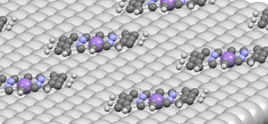 The characteristics of interaction between transition-metal molecules and metallic surfaces ware detailed as resulted from DFT calculations. Van der Waals interactions as well as the strong correlation in 3d orbitals of transition metals is taken into account in all calculations. We showed that the interaction between the transition metal and surface is the result of a combination between the dispersion interaction, charge transfer and weak chemical interaction. The detailed analysis of the physical properties, such as dipolar and magnetic moments and the molecule–surface charge transfer, analyzed for different geometric configurations allows us to propose qualitative models, relevant for the understanding of the self-assembly processes and related phenomena.
[1] L. Buimaga-Iarinca, C. Morari, Scientific Reports | (2018) 8:12728 | doi:10.1038/s41598-018-31147-5
[2] L. Buimaga-Iarinca, C. Morari, Beilstein J. Nanotechnol | (2019) 10:706–717|doi: 10.3762/bjnano.10.70
[3] L. Buimaga-Iarinca, C. Morari, Nanotechnology | (2019) 30:045204|doi:10.1088/1361-6528/aaed75
Topological phase-diagram for magnetic impurities adsorbed on NiSe2 surfaces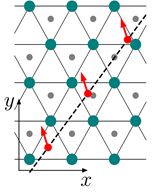
Recent experimental studies have found that magnetic impurities deposited on superconducting monolayer NbSe2 generate coupled Yu-Shiba-Rusinov bound states. In this context, we considered ferromagnetic chains of impurities which induce a Yu-Shiba-Rusinov band and harbor Majorana bound states at the chain edges. We found that these topological phases are stabilized by strong Ising spin-orbit coupling in the monolayer and estimated the conditions under which Majorana phases appear as a function of distance between impurities, impurity spin projection, orientation of chains on the surface of the monolayer, and strength of magnetic exchange energy between impurity and superconductor.
[1] D. Sticleț, C. Morari, Phys. Rev. B | (2019) 100:075420 | doi: 10.1103/physrevb.100.075420